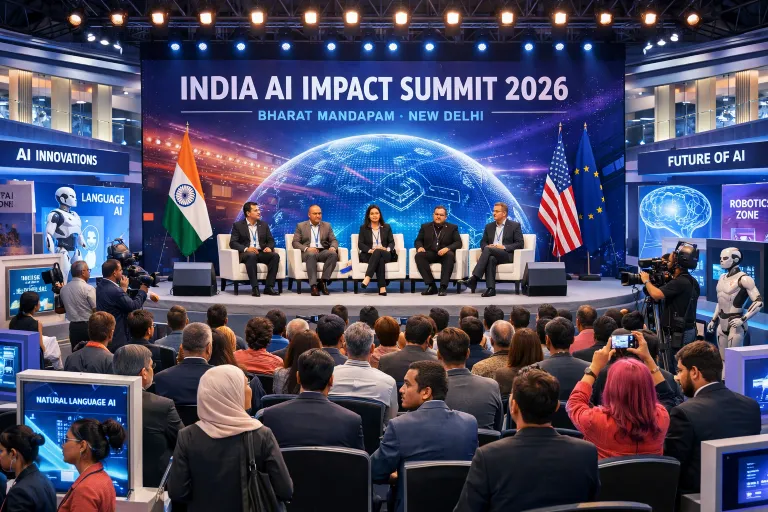
Artificial intelligence (AI) is rapidly transforming economies, societies, and human productivity around the world. In February 2026, India emerged as a global focal point for AI leadership by hosting the India AI Impact Summit 2026 in New Delhi. This landmark event brought together governments, industry giants, researchers, civil society, and innovators from across the globe — aiming to align AI development with inclusive progress and ethical deployment.
In this comprehensive blog, we explore the summit’s genesis, core themes, major announcements, key participants, controversies, and long-term implications for India and the world.
What Is the India AI Impact Summit?
The India AI Impact Summit 2026 was more than just a conference — it was a global platform designed to catalyze real-world AI deployment, public-private partnerships, and multilateral cooperation. Organized under the IndiaAI Mission by the Ministry of Electronics and Information Technology, the summit took place from 16–21 February 2026 at Bharat Mandapam, New Delhi.
This summit marked the fourth in a series of major international AI events — following summits in Bletchley Park, Seoul, and Paris — and was notable for being the first hosted by a Global South nation.
The Vision Behind the Summit
At its core, the India AI Impact Summit sought to turn AI from theoretical promise into measurable impact. Its ambitious goals included:
- Promoting ethical, responsible, and equitable AI development.
- Harnessing AI to solve real social and economic challenges.
- Building global coalitions to democratize access to AI resources and infrastructure.
- Strengthening capacity building and human capital development.
This vision was realized through a week of plenary sessions, workshops, policy dialogues, tech displays, and research showcases that connected innovation with implementation.
The Three Pillars: People, Planet, Progress
The summit’s structure centered on three foundational pillars — often referred to as Sutras:
People
This pillar focused on AI’s role in enhancing human potential, expanding educational access, skilling the workforce, and preparing communities for future jobs shaped by AI innovation.
Planet
AI was framed as a tool to tackle global challenges such as climate change, sustainability, public health, and disaster resilience — using data to protect natural resources.
Progress
Progress emphasized economic growth, inclusion, smart infrastructure solutions, and ethical governance frameworks to ensure that technological development benefits everyone.
Massive Global Participation
The scale of the Summit was unprecedented:
- Over 80 countries signed a historic Delhi Declaration calling for democratic and ethical AI for social good.
- Heads of state, including India’s Prime Minister and international leaders, delivered keynote addresses.
- CEOs from major global tech firms (e.g., Google, Microsoft, Amazon, OpenAI) participated in discussions and partnerships.
Additionally, the World Bank, multinational organizations, research institutions, and AI innovators contributed to thought leadership and collaborative sessions.
India AI Impact Expo: Showcasing Innovation
Running alongside the summit was the India AI Impact Expo 2026 — a massive exhibition designed to demonstrate practical AI solutions. Spanning tens of thousands of square meters, the expo featured:
- 400+ exhibitors from around the world.
- 10+ thematic zones highlighting AI applications in areas like healthcare, education, sustainability, and industrial automation.
This format allowed attendees to interact with real use-cases rather than just conceptual talks, emphasizing the summit’s core theme: impact over hype.
Major Announcements & Outcomes
Several groundbreaking developments emerged from the summit:
AI Infrastructure Expansion
The Indian government committed to significantly expanding the nation’s AI computing infrastructure — including the deployment of new GPUs to support domestic AI research and product development.
Foundational AI Models
Indian and global AI labs showcased advanced models tailored for local languages and contexts — including multimodal systems and voice-enabled tools that support India’s linguistic diversity.
Investment Pledges
Billions of dollars in new investments were pledged to support AI innovation ecosystems, research collaboration, and data infrastructure — demonstrating confidence in AI’s economic potential.
Societal Impact Campaigns
A world record was set for the most pledges collected for a campaign promoting AI responsibility — reflecting public engagement and ethical awareness.
Key Themes Explored
AI for Social Good
Sessions focused on how AI can improve healthcare delivery, agriculture yields, disaster response, and public service efficiency.
Safe and Trusted AI
Experts debated governance norms, bias mitigation, data privacy standards, and ethical auditing methods to ensure AI systems are fair and reliable.
Human Capital and Skilling
Thought leaders emphasized equipping people with AI literacy and job-ready skills. Workshops highlighted strategies for integrating AI into education, training, and workforce development.
Democratizing AI Access
A recurring objective was to bridge the digital divide by enabling affordable AI tools, democratizing compute access, and encouraging open innovation globally.
Criticisms and Controversies
Large events often invite scrutiny, and the India AI Impact Summit was no exception:
Organizational Challenges
Many attendees reported logistical bottlenecks, overcrowding, and registration issues due to high turnout. Some sessions faced access challenges, fueling criticism about execution and planning.
Political Tensions
Protests by political groups during the summit sparked debates about decorum and national image at tech events — highlighting that technological discourse often intertwines with broader civic concerns.
Despite these issues, many participants expressed optimism about India’s willingness to host global AI conversations and the value of the dialogues that took place.
Why the Summit Matters
The India AI Impact Summit 2026 was more than a policy summit or tech fair — it represented a shift toward practical, inclusive, and globally cooperative AI development. Its significance lies in several key areas:
Leadership in the Global South
By hosting this summit, India signaled that cutting-edge AI development is not the exclusive domain of Western tech hubs. Instead, developing nations have agency and vision to shape AI’s global trajectory.
Ethical and Inclusive AI
The signing of the Delhi Declaration affirmed that AI should prioritize human centricity, fairness, and social welfare — principles essential to sustainable technological progress.
Real-World Application
The integration of expo demonstrations, investment pledges, and policy dialogue reinforced that AI’s next frontier lies in adoption — not abstraction — across sectors like healthcare, education, agriculture, and governance.
Long-Term Impact and Outlook
Looking ahead, the India AI Impact Summit lays the groundwork for:
- Stronger international mechanisms for AI governance and safety.
- Expanded AI infrastructure supporting research and startups.
- Enhanced collaboration between governments, industry, and academia.
- Practical AI solutions embedded in public services and livelihoods.
If fully realized, the momentum from this summit could reshape how nations approach development, inclusion, and technological equity in the age of artificial intelligence.