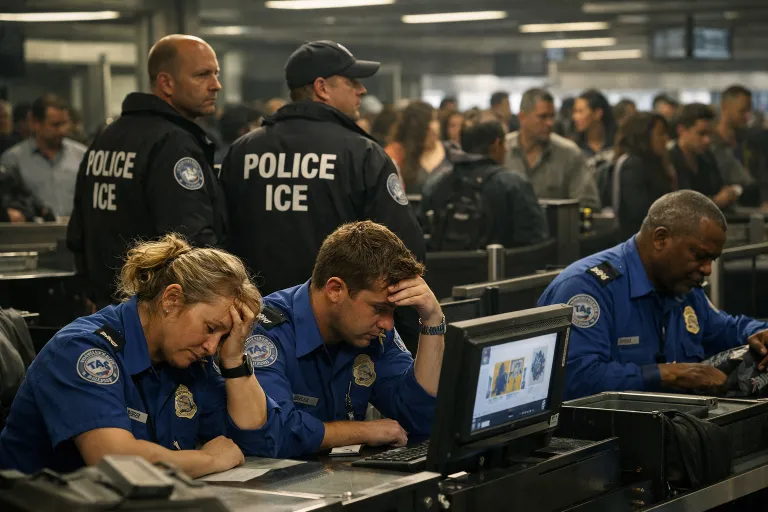
The United States is once again facing a major government shutdown crisis—but this time, the consequences are hitting closer to everyday life than ever before. At the center of it all are the hardworking employees of the Transportation Security Administration (TSA), who are showing up to work without pay while dealing with an unexpected and controversial influx of Immigration and Customs Enforcement (ICE) agents at airports.
If you think this is just another political standoff, think again. This situation is affecting airport security, travel experiences, worker morale—and even raising serious concerns about safety and governance.
Let’s break it all down in a compelling, easy-to-understand way 👇
✈️ What’s Happening Right Now?
A partial shutdown of the Department of Homeland Security (DHS) has dragged on for weeks, leaving thousands of TSA workers unpaid. Meanwhile, ICE agents—who are funded through a separate long-term budget—continue to receive salaries and have been deployed to assist at airports.
This unusual situation has created a striking contrast:
- TSA officers: Working without pay or calling out
- ICE agents: Paid and newly assigned to airport duties
The result? A tense, chaotic environment across major U.S. airports.
💼 TSA Workers: “We Need to Be Paid”
Imagine going to work every day knowing you won’t receive a paycheck. That’s the reality for TSA officers right now.
- Over 3,000+ TSA workers have called out in a single day
- Hundreds have already quit due to financial strain
- Many are still recovering from a previous shutdown
These are not just numbers—these are real people struggling to pay rent, buy groceries, and support their families.
TSA agents are considered “essential workers,” meaning they must continue working even without pay. But as the shutdown drags on, morale is collapsing.
🛂 Why Are ICE Agents Getting Paid?
Here’s where things get even more controversial.
ICE continues to operate normally because of a massive funding allocation passed earlier, making it effectively “shutdown-proof.”
That means:
- ICE agents are still being paid
- TSA workers are not
- Both are now working side by side at airports
This pay disparity has sparked outrage—not just among workers, but also among unions and travelers.
⚠️ The Big Concern: Are Airports Still Safe?
Let’s be clear: TSA officers undergo specialized training for aviation security—screening passengers, detecting threats, and managing airport safety.
ICE agents, on the other hand, are trained for immigration enforcement—not airport screening.
Critics, including the American Federation of Government Employees, argue that replacing or supplementing TSA roles with ICE agents could:
- Compromise security protocols
- Slow down screening processes
- Increase confusion at checkpoints
Even travelers have reported longer wait times and confusion at major airports.
😟 Public Reaction & Viral Incidents
The deployment of ICE agents has not gone unnoticed.
- Viral videos show confrontations between travelers and agents
- Concerns about wrongful detentions have surfaced
- Civil rights groups are raising alarms about transparency
In one widely discussed case, confusion at an airport led to fears that even citizens could be detained—though officials later clarified details.
This blending of immigration enforcement with airport security is creating anxiety among passengers.
🏛️ The Political Standoff Behind It All
So why is this happening?
At its core, this crisis stems from a political battle over:
- Immigration reform
- ICE oversight
- Federal funding priorities
One side is pushing for stricter controls and continued ICE funding, while the other demands reforms before approving DHS funding.
The result? A prolonged shutdown where:
- TSA suffers
- ICE continues operating
- Travelers face disruptions
📉 Economic & Travel Impact
The ripple effects go far beyond airport lines.
- Delays during peak travel seasons (like spring break)
- Increased wait times (up to 4+ hours in some cases)
- Potential billions in economic losses if shutdown continues
Air travel is a backbone of the U.S. economy—and disruptions here can impact tourism, business travel, and global connectivity.
🔁 A Repeat Crisis: Why This Feels Familiar
This isn’t the first time TSA workers have faced unpaid work during a shutdown.
In fact:
- This is the second shutdown in a short period
- Workers are experiencing repeated financial instability
- Trust in the system is eroding
Each shutdown leaves deeper scars on the workforce.
🧭 What Happens Next?
There are a few possible outcomes:
✅ 1. Political Agreement
Lawmakers could reach a compromise, restoring funding and paying TSA workers.
⚠️ 2. Continued Shutdown
If negotiations fail, expect:
- More TSA absences
- Longer airport delays
- Greater public frustration
🔄 3. Policy Changes
This crisis could lead to:
- Reforms in ICE operations
- Changes in TSA funding structures
- New rules for handling shutdowns
💡 Final Thoughts: A System Under Stress
This situation reveals a deeper issue within government systems:
- Essential workers are being asked to carry the burden of political disagreements
- Funding priorities can create inequality within the same department
- Public safety systems depend heavily on workforce stability
At the heart of it all is a simple message from TSA workers:
“We need to be paid.”
Until that happens, this crisis will continue to affect not just workers—but millions of travelers every day.