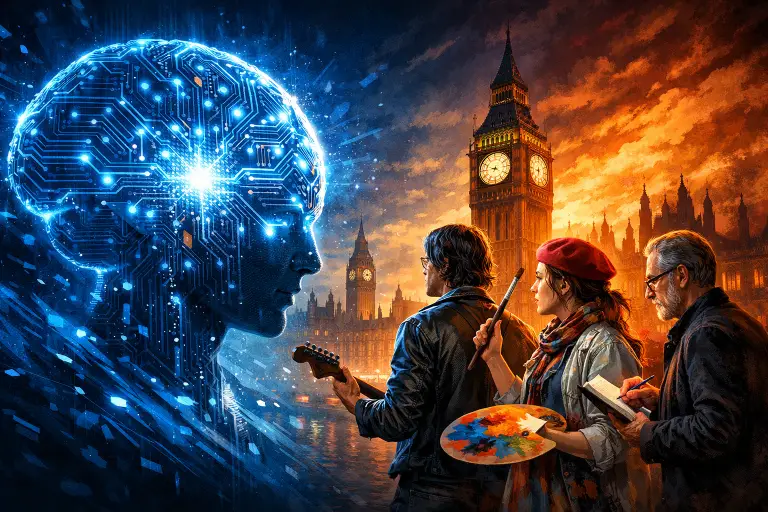
Artificial Intelligence (AI) is transforming industries worldwide—from healthcare and finance to entertainment and education. Yet its rapid rise has triggered intense debate about its impact on creativity, copyright, and cultural industries. In the United Kingdom, lawmakers and creative professionals are raising serious concerns that the rush to develop AI technology could come at the cost of the country’s vibrant arts sector.
Recently, members of the UK’s House of Lords warned that the government must not sacrifice the nation’s creative industries in pursuit of speculative gains from artificial intelligence. Their warning highlights the growing tension between technological innovation and the protection of artists, writers, musicians, and other creators.
This debate reflects a broader global challenge: how to harness the potential of AI while safeguarding the value of human creativity.
The UK Creative Industries: A Global Cultural Powerhouse
The United Kingdom is widely recognized as one of the world’s cultural leaders. Its creative industries—including music, film, television, literature, theater, fashion, and gaming—are not only culturally significant but also economically vital.
According to policymakers, the sector contributes approximately £146 billion annually to the UK economy, employing millions of people across the country.
British cultural exports such as films, television series, music, and video games influence global audiences. From iconic musicians and bestselling authors to world-renowned theaters and design studios, the UK’s artistic ecosystem forms a major part of its national identity.
However, many creators fear that new policies related to AI development could undermine this success.
Why AI Is Creating Tension in the Creative World
Generative AI tools—capable of producing text, music, images, and videos—are typically trained on vast datasets gathered from the internet. These datasets often include copyrighted material such as books, paintings, songs, and articles.
Artists argue that their work is being used to train AI systems without permission or compensation. Critics say this practice allows AI companies to profit from creative work while the original creators receive nothing in return.
In practical terms, AI models can learn patterns from existing works and then generate new outputs that resemble a specific style or artistic approach. For example:
- AI can generate music similar to famous artists.
- AI image generators can produce artwork resembling particular painters.
- AI writing tools can replicate narrative styles of authors.
- While developers view this as technological progress, many creators see it as exploitation.
The House of Lords Warning
A report from a House of Lords committee has urged the UK government to rethink proposed changes to copyright law that could benefit AI developers at the expense of artists.
Peers warned that the creative industries should not be sacrificed for “speculative gains” in artificial intelligence.
The committee’s recommendations include:
1. A Licensing System for AI Training
Rather than allowing AI companies to freely scrape creative works, lawmakers recommend establishing a licensing framework. This would ensure that creators are compensated when their work is used to train AI systems.
2. Transparency in AI Training Data
AI developers should disclose what content their systems are trained on. This transparency would help creators identify whether their work has been used without consent.
3. Stronger Copyright Protection
The report urges the government to abandon proposals that weaken copyright laws, emphasizing that creative workers deserve protection and fair payment.
4. Safeguards Against Deepfakes
The committee also warned about AI-generated deepfakes and the potential misuse of artists’ voices, likenesses, or creative styles.
These recommendations aim to balance innovation with fairness.
Controversial AI Copyright Proposals
At the center of the debate is a proposal that could allow AI firms to use copyrighted material without prior permission.
Some policymakers have suggested a “commercial research exception” that would permit AI companies to use copyrighted works for development purposes.
Under such proposals:
- AI developers could train models on publicly available content.
- Creators might only receive compensation when AI products are commercialized.
Critics argue that this system favors large tech companies and places an unfair burden on artists.
Another proposal previously discussed involved an opt-out system, where creators would have to actively request that their work not be used for AI training.
Many artists say this is unrealistic because it would require constant monitoring of countless datasets.
Artists Speak Out Against AI Policies
Prominent musicians and cultural figures have joined the debate, warning that weak copyright protection could damage the creative economy.
Music legend Elton John strongly criticized earlier proposals that would allow tech firms to train AI on artists’ work without payment. He described the idea as “theft” and warned that it could harm emerging artists who rely on copyright income.
Other well-known musicians, writers, and industry leaders have echoed similar concerns, arguing that:
- AI companies should not profit from creative labor without compensation.
- Copyright is essential for sustaining artistic careers.
- Weak protections could discourage future creators.
The issue has united artists across different disciplines.
The Economic Stakes
The debate is not just about art—it’s also about economics.
The UK government hopes to become a global leader in artificial intelligence. The AI sector promises:
- technological innovation
- new startups and investments
- economic growth
However, critics argue that prioritizing AI at the expense of creative industries could backfire.
Creative sectors already generate substantial economic value and employ millions. Weakening copyright protections could reduce income for artists, writers, and designers.
If creative professionals feel their work is no longer protected, it could discourage innovation and reduce the quality of cultural output.
The Ethical Questions Around AI and Creativity
Beyond economics, the issue raises fundamental ethical questions.
Who owns creativity?
If an AI system generates art based on thousands of human works, who owns the result?
Should artists be compensated?
If AI models rely on copyrighted works for training, should creators receive royalties?
Can AI replace human creativity?
AI can replicate styles and produce content quickly, but many argue it lacks emotional depth and human experience.
Academic research suggests that while AI can assist creativity, it also raises concerns about authenticity, ownership, and fairness in artistic production.
These questions have no simple answers.
The Global Race for AI Leadership
The UK’s policy debate also reflects international competition.
Countries like the United States, China, and Japan are investing heavily in AI development. Some policymakers fear that strict copyright rules could push AI companies to relocate to more flexible jurisdictions.
However, others argue that strong protections could make the UK a leader in ethical AI development.
If the UK creates a balanced system that respects creators while enabling innovation, it could set global standards for responsible AI.
Finding the Balance: Innovation vs Protection
Many experts agree that the solution is not choosing between AI and creativity.
Instead, the goal should be to build a system where both can thrive.
Possible solutions include:
Licensing frameworks
AI companies pay creators for training data.
Transparency rules
Developers disclose training datasets.
Revenue-sharing models
Artists receive royalties when AI products use their work.
Ethical AI standards
Regulations prevent misuse of artistic content and deepfakes.
Such policies could foster collaboration between artists and technology companies rather than conflict.
The Future of Human Creativity in the AI Era
Artificial intelligence is undoubtedly transforming the creative landscape. AI tools can assist with writing, design, music production, and filmmaking.
For many creators, these technologies can become powerful tools rather than threats.
However, the key challenge lies in ensuring that the benefits of AI are distributed fairly.
Human creativity remains the foundation of culture. Without writers, musicians, designers, and artists, the datasets that power AI systems would not exist.
Protecting creative rights is therefore not just about fairness—it’s about sustaining the ecosystem that fuels innovation.
Conclusion
The warning from UK peers highlights a critical moment in the relationship between artificial intelligence and the arts. While AI offers enormous opportunities for technological progress, policymakers must ensure that innovation does not come at the cost of human creativity.
The UK’s creative industries represent both cultural heritage and economic strength. Sacrificing them for uncertain AI gains could have long-term consequences.
The challenge for governments worldwide is to create policies that encourage technological advancement while protecting the artists whose work inspires it.
Ultimately, the future should not be about AI replacing human creativity—but about AI supporting and amplifying it.