Maritime collisions involving warships are rare — especially for highly trained naval forces like the United States Navy — but when they do happen, the consequences can be devastating, both humanly and operationally. From peacetime mishaps during training or logistics operations to deadly collisions that result in loss of life, these incidents force the Navy to examine its procedures, navigation systems, and decision-making practices at sea.
In recent years the U.S. Navy has experienced several notable collisions involving its vessels — ranging from collisions with other Navy ships, civilian merchant traffic, and even complex accidents during underway replenishment exercises. This blog explores the full history of US Navy ship collisions, the causes behind them, their impact, and what they mean for naval operations and safety today.
A Rare But Persistent Maritime Risk
At first glance, it may seem surprising that modern warships — staffed with hundreds of trained crewmen and equipped with advanced radar and navigation systems — could ever collide. Yet the ocean is a dynamic environment where many factors challenge even the best-trained teams. Fog, mechanical failure, human error, navigation miscalculations, complex multi-ship maneuvers, and operational pressures all play roles in collision risk. Over decades, even ships of the U.S. Navy’s fleet have been involved in a host of accidents at sea.
The Latest Incident: USS Truxtun and USNS Supply (2026)
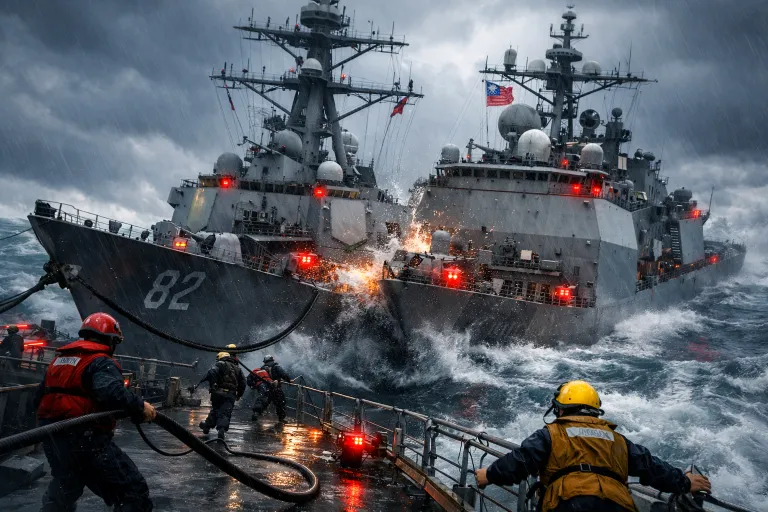
In February 2026, two U.S. Navy vessels collided during a routine at-sea replenishment operation in the Caribbean Sea.
What Happened
- The guided-missile destroyer USS Truxtun (DDG-103) and the fast combat support ship USNS Supply (T-AOE-6) collided while conducting a replenishment-at-sea (RAS) — a complex maneuver where two ships sail side-by-side to transfer fuel and supplies.
- Replenishment at sea requires careful station-keeping while both ships maintain precise course and speed. Any variation in wind, waves, or propulsion synchronization increases the risk of contact.
Impact & Outcome
- Two sailors sustained minor injuries and were reported stable.
- Both ships remained operational — though subject to damage assessments.
- The incident is currently under investigation by Navy authorities to determine causes, including whether procedural, mechanical, or human factors played the primary role.
This collision highlights a modern logistic challenge: even non-combat operations like resupply can present serious hazards.
Notable Historic US Navy Collisions
Although rare, there have been several major collisions involving U.S. Navy vessels — some resulting in loss of life, extensive damage, and significant operational review.
a. USS Fitzgerald and MV ACX Crystal (2017)
The USS Fitzgerald, an Arleigh-Burke class destroyer, collided with the Philippine-flagged container ship MV ACX Crystal off Japan in June 2017.
- Seven U.S. sailors lost their lives in this accident.
- Investigations pointed to situational awareness failures and crew decision-making lapses.
- The incident led to disciplinary action and renewed emphasis on crew training and bridge watch standards.
This event remains one of the deadliest peacetime collisions in recent U.S. Navy history.
b. USS Greeneville and Ehime Maru (2001)
In February 2001, the submarine USS Greeneville (SSN-772) surfaced abruptly beneath the Japanese training vessel Ehime Maru, causing the latter to sink quickly.
- The collision resulted in nine deaths, including students and teachers aboard the training ship.
- Civilian VIPs were aboard the Greeneville at the time, contributing to criticism of procedural oversight.
- The incident led to policy changes regarding civilian tours and submarine surfacing procedures.
c. USS Hartford and USS New Orleans (2009)
In a rare occurrence between two Navy vessels, the submarine USS Hartford collided with the amphibious transport dock USS New Orleans in March 2009.
- Both ships sustained serious damage and 15 sailors were injured.
- Investigations cited complacency and poor bridge communication.
- The accident underscored how complex navigational challenges — even for subsurface vessels — can lead to mishaps.
d. Earlier Historical Collisions
- USS Porter (2012): Collided with an oil tanker near the Strait of Hormuz.
- USS Wasp and USS Hobson (1952): Night operations led to a catastrophic collision, killing 176 sailors.
These incidents underscore the fact that collisions — whether during combat, maneuvering, or routine operations — have long shaped naval safety protocols.
Other Related Incidents Involving Navy Vessels
Not all accidents involve like-for-like ship collisions, but they reveal similar themes.
USS Harry S. Truman Collision (2025)
In February 2025, the aircraft carrier USS Harry S. Truman collided with the merchant vessel Besiktas-M near Egypt during Mediterranean operations
- No injuries were reported, but the incident triggered investigations into navigation during congested international shipping lanes.
Broader Deployment Issues
Naval deployments over time — such as in the Middle East — have seen jets lost overboard and other accidents linked to procedural breakdowns and crew fatigue.
While not strictly collisions, these events reflect the broad safety challenges faced by a global navy operating under high tempo conditions.
Common Causes Behind Navy Ship Collisions
A review of collisions reveals several recurring factors:
📍 Human Error
Situational awareness breakdowns, miscommunication on bridge teams, and misinterpreted navigational data are frequent culprits in collisions like the USS Fitzgerald incident.
📍 Complex Maneuvers
Replenishment-at-sea, tight formations, or navigation through narrow straits (e.g., Hormuz) require precise coordination. Small errors at high speeds can escalate rapidly.
📍 Fatigue and Operational Tempo
Long deployments and high operational demand can result in crew fatigue, affecting judgment and reaction time — a factor highlighted in broader Navy incident reviews.
📍 Navigation Challenges
Heavy shipping traffic, environmental conditions, and limited communication with civilian vessels can create collision risks, especially near busy ports or straits.
Aftermath: Investigations and Reforms
Every collision triggers formal Navy investigations — often involving the Judge Advocate General’s Corps, Naval Safety Center, and fleet command. Findings can lead to:
- Dismissal or relief of commanding officers.
- Revised navigation and bridge team training.
- Improved use of collision avoidance systems.
- Changes in operational procedures — especially in peacetime logistics exercises.
These reforms aim not only to assign accountability but to ensure lessons are learned and similar events prevented.
Technology’s Role in Collision Avoidance
As ships become more automated, technology assists navigation:
- Radar and multi-sensor fusion systems
- Automated collision avoidance software
- Improved communications networks
Yet technology isn’t infallible — it must work in tandem with trained crews proficient in seamanship and decision-making under pressure.
Lessons Learned and Looking Ahead
Collisions at sea — though rare — remind us that even powerful navies are vulnerable to accidents. The Navy continues to refine training, adopt new technologies, and analyze operational data to mitigate collision risks.
Future initiatives likely include:
- Enhanced bridge team training simulations
- Better human-machine interface for navigators
- Fatigue management protocols
- International coordination with civilian maritime authorities
As naval operations evolve — from fleet sailing to integrated multi-domain missions — minimizing avoidable accidents remains a top priority.
Conclusion
When U.S. Navy ships collide, it sends ripples throughout the service and beyond — prompting investigation, introspection, and reform. From heartbreaking tragedies to minor but telling incidents, each collision tells a story not just about risk at sea, but about the people, technology, and organizational culture that define naval operations.
Whether during training, resupply, or active deployment, collision avoidance remains an essential element of maritime safety — and one that demands continual vigilance, discipline, and innovation.