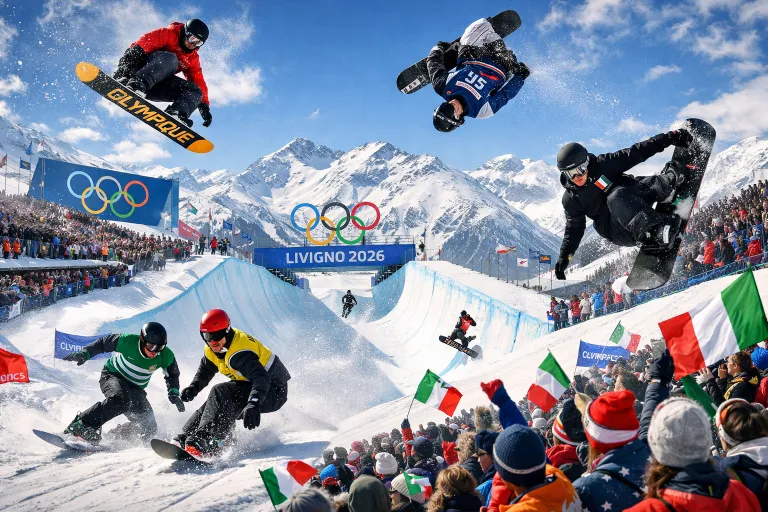
The 2026 Winter Olympics snowboarding competition is one of the most exciting and talked-about parts of the Milano-Cortina Winter Games. With breathtaking tricks, high-speed races, and elite athletes from around the world, snowboarding delivers drama, skill, and unforgettable moments. From the first event on February 5 through February 18, 2026, fans will witness 11 medal events across five disciplines at the stunning Livigno Snow Park in northern Italy.
In this guide, we’ll explore everything you need to know — from event formats and how scoring works, to top athletes, medal predictions, and tips on watching every thrilling run.
📍 Why Snowboarding Is a Star Sport in the Winter Olympics
Snowboarding has become one of the most popular Winter Olympic sports since its Olympic debut at the Nagano Games in 1998. Combining technical difficulty with athletic creativity, it appeals to fans who love high-flying action and cutting-edge tricks. Its evolution from fringe “snow culture” into mainstream competition showcases the sport’s growing global influence.
At Milano-Cortina 2026, snowboarding once again stars alongside classics like figure skating and skiing as one of the most watched disciplines. It blends speed, style, and strategy across separate events — keeping spectators riveted throughout the two weeks.
📅 Snowboarding Events & Schedule
Snowboarding at the 2026 Winter Olympics takes place from February 5 to February 18, 2026, in Livigno Snow Park — a world-class mountain venue perfect for high-stakes competition.
Here’s how the events are structured:
🎿 Snowboarding Disciplines
There are five main disciplines:
- Big Air
- Slopestyle
- Halfpipe
- Snowboard Cross
- Parallel Giant Slalom
- Mixed Team Snowboard Cross (newer team format)
📆 Official Olympic Competition Schedule (summary):
- Big Air – Feb 5-9
- Parallel Giant Slalom – Feb 8
- Halfpipe – Feb 11-13
- Snowboard Cross – Feb 12-15
- Slopestyle – Feb 16-18
This spread gives athletes time to compete at peak performance and gives fans a chance to catch every thrilling moment.
🏆 Snowboarding Disciplines Explained
Let’s break down each event so you understand exactly what makes them unique and exciting.
🪂 Big Air: A Show of Height and Style
Big Air involves riders launching from a massive jump and performing the most difficult tricks they can muster. Judges score based on difficulty, execution, amplitude, and landing — combining athleticism with flair.
- Competitors get three runs in qualifiers and finals.
- Only the top scores count.
At the 2026 Games, Japan’s Kira Kimura won the Men’s Big Air gold medal, edging out teammate Ryoma Kimata. China’s Su Yiming took bronze, adding another Olympic medal to his collection. 🇯🇵🥇🇯🇵🥈🇨🇳🥉
Slopestyle: Creativity Meets Precision
Slopestyle challenges riders to complete a course filled with rails, jumps, and obstacles — performing complex tricks from start to finish.
Scoring in slopestyle combines:
- Trick difficulty
- Amplitude
- Flow
- Landing quality
Nearly every athlete in slopestyle also competes in big air, making these events interconnected showcases of versatility.
🌀 Halfpipe: The Classic Crowd-Pleaser
Halfpipe is one of snowboarding’s signature events. Riders drop into a U-shaped snow structure and perform tricks off each wall, trying to build height and link together combinations.
In 2026:
- Riders receive three runs in finals;
- Only their best score counts toward medals.
Halfpipe tests strength, timing, and nerves. Frequent medal favorites here include veterans with years of experience and young riders looking to make their mark.
🏁 Snowboard Cross: Speed & Strategy
Snowboard cross is pure adrenaline. Multiple riders race simultaneously down a course filled with jumps, banked turns, and berms.
This event is unpredictable — one mistake can change the leaderboard instantly. At Milano-Cortina, snowboard cross includes both individual men’s and women’s races, plus a Mixed Team event, which emphasizes team strategy along with speed.
⛔ Parallel Giant Slalom: Tech Meets Speed
Parallel Giant Slalom is reminiscent of alpine skiing. Two athletes race side by side down mirror courses, navigating gates with precision and speed.
The head-to-head nature makes this one of the most tactical snowboarding events, requiring split-second decisions and razor-sharp focus.
Medal hopefuls often come from countries with strong technical riding traditions.
🏅 Top Athletes & Medal Contenders
The 2026 Winter Olympics snowboarding events feature an incredible roster of talent — from seasoned champions to rising superstars.
🇺🇸 United States
The U.S. snowboarding team always brings firepower — especially in halfpipe and slopestyle. With athletes who have a track record in X Games and World Cups, American riders remain medal threats.
🇯🇵 Japan
Japan is proving to be a snowboarding powerhouse in 2026. Kira Kimura and Ryoma Kimata showed it by taking gold and silver in Men’s Big Air — a sensational result early in the snowboarding program.
🇨🇳 China
Su Yiming continues to impress, adding another Olympic medal to his collection and demonstrating technical consistency across disciplines.
🇬🇧 Great Britain
Athletes like Mia Brookes are among the favorites in women’s big air and slopestyle, thanks to standout World Cup performances.
🇦🇺 Australia
Riders such as Valentino Guseli brought dramatic narratives to the big air final — qualifying late and pushing the limits despite not medaling.
📊 Snowboarding Scoring & Judging
Snowboarding scoring can be complex, but understanding it makes watching the sport even more exciting.
🧠 Freestyle Scoring (Halfpipe & Slopestyle)
Judges score on a 100-point scale based on:
- Difficulty
- Execution
- Amplitude
- Originality
- Variety
Typically
- Two runs in qualification
- Best score counts
- Three runs in finals, best counts
This system rewards consistency and innovation — riders who push boundaries in new ways are often rewarded.
📺 How to Watch Snowboarding in 2026
Fans around the world can catch every moment of the snowboarding action:
🔹 NBC & USA Network broadcast live events in the United States
🔹 Peacock offers streaming coverage including replays and highlights
🔹 Official Olympics platforms provide daily schedules and results
International broadcasters and streaming platforms also cover snowboarding events for fans worldwide.
🧠 Snowboarding Trends & What to Expect
🔥 Increasing Global Competition
Snowboarding’s competitive field is deeper than ever. Countries outside the traditional winter-sport powerhouses are now challenging for medals, making every event unpredictable.
🧗♂️ Technical Progression
Moves once considered impossible are now breakfast routines for top riders. Expect triple corks in slopestyle and massive spins in big air.
The Venue: Livigno Snow Park
Livigno Snow Park in Italy’s Valtellina region is hosting all snowboarding events. Known for its perfect snow and world-class facilities, this venue offers dynamic courses for each discipline — from big air jumps to slick snowboard cross tracks.
🧳 Final Thoughts
Snowboarding at the 2026 Winter Olympics is more than a competition — it’s a celebration of athleticism, creativity, and global sportsmanship. From the electrifying big air finals to the strategic precision of parallel giant slalom, this year’s snowboarding events are destined to be talked about for years to come.
Whether you’re watching for the high-flying tricks or cheering for your favorite rider, the 2026 snowboarding program has something unforgettable for every fan.